2025 - Winter Tire Report
TRAC’s 2025 Canadian Consumer Winter Tire Study shows Canadians increasingly recognize the role winter tires play in road safety as winter conditions become more unpredictable.
About This Report
Tire and Rubber Association of Canada’s Winter Tire Report assesses public perception and the market for winter tires in Canada. This report is made available to stakeholders in the tire and automotive industries, including tire and car manufacturers, retailers, government, road safety advocacy groups, media, and consumers.
The scope of this report applies to passenger and light truck vehicle categories only.
TRAC reviewed and analyzed a broad range of market data and research on consumer perceptions related to winter tires in order to provide recommendations on educating Canadian motorists on safety and performance benefits of winter tires.
About TRAC’s 2025 National Survey Instrument
Probe Research is a leading Canadian provider of public opinion and market research insights. Probe’s vision is to create knowledge by helping citizens, consumers and stakeholders better understand one another and the world around them (www.probe-research.com).
Three quarters of Canada’s drivers believe extreme weather related to climate change is making winter tires more important than ever.
Key Findings
TRAC’s 2025 Canadian Consumer Winter Tire Study shows Canadians increasingly recognize the role winter tires play in road safety as winter conditions become more unpredictable. More than three-quarters of drivers, 76%, believe extreme weather linked to climate change has made winter tires more important than ever. This season, 80% of Canadian drivers report using winter tires, a two-point increase from 2024 and a 12-point rise since 2016. Outside of Quebec, where winter tires are mandated by law, adoption remains strong at 76%.
The study also highlights strong confidence in the real-world safety benefits of winter tires. Among winter tire users, 84% believe their tires have helped them avoid a potentially hazardous situation, including loss of control or a collision, and 70% say protecting their family is a primary motivator. At the same time, cost pressures are shaping decisions. While 81% consider winter tires a worthwhile investment despite rising living costs, 32% say they are less likely to purchase them this season due to affordability concerns.
Overall, winter tire adoption in Canada continues to trend upward, reflecting growing awareness of their proven safety value. TRAC remains committed to working with government, industry, road safety organizations and partners to promote safe winter driving and educate consumers about the critical role winter tires play in protecting Canadians on winter roads.
Canadians recognize that winter tires are essential for safe driving, especially as extreme weather events become more frequent. It’s very encouraging to see that 80% of drivers now use winter tires. However, we also know that the rising cost of living is forcing some drivers to make difficult choices. That’s why TRAC is committed to working with government, industry, road safety organizations and other stakeholders to ensure that Canadians understand the safety and performance benefits of winter tires and make informed decisions that keep their families safe.Carol Hochu President & CEO, TRAC
Winter Tire Usage in Canada
TRAC 2025 Canadian Consumer Winter Tire Study
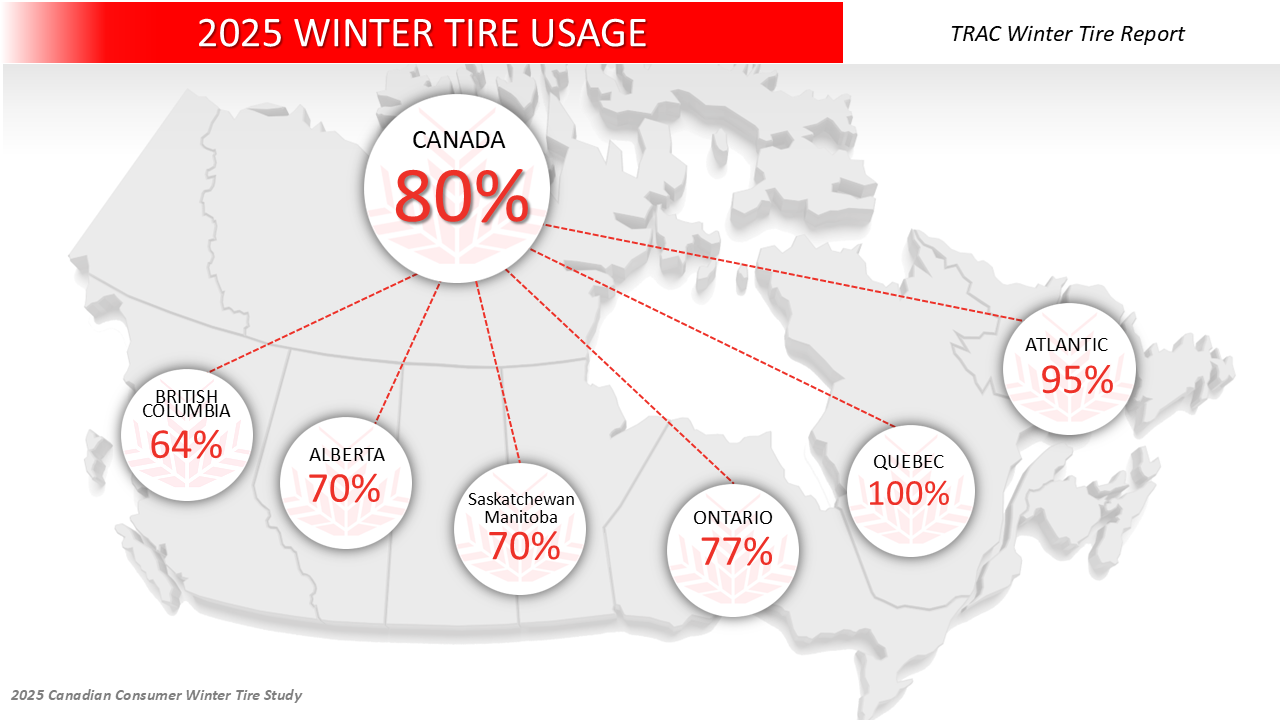
In 1998 only 35% of Canadian drivers used winter tires. That figure has more than doubled in 2025. TRAC’s 2025 Canadian Consumer Winter Tire Study shows that winter tire usage had grown to 80%, which is a 12-point increase since 2016. Excluding Quebec, where winter tires are mandatory, 76% of the Canadian drivers will use winter tires in the 2025/2026 winter season.
Winter Tire Use by Region:
Winter Tire Usage
| Year / Province | 2025 (%) | 2024 (%) | 2023 (%) | 2022 (%) | 2021 (%) | 2020 (%) |
|---|---|---|---|---|---|---|
| National | 80 | 78 | 76 | 70 | 76 | 72 |
| Atlantic Canada | 95 | 85 | 94 | 74 | 92 | 84 |
| Quebec* | 100 | 100 | 100 | 100 | 100 | 100 |
| Ontario | 77 | 74 | 67 | 65 | 73 | 66 |
| Manitoba/Saskatchewan | 70 | 69 | 64 | 58 | 50 | 60 |
| Alberta | 70 | 69 | 73 | 56 | 68 | 59 |
| British Columbia | 64 | 68 | 73 | 59 | 57 | 60 |
Driver Perception of Winter Tires
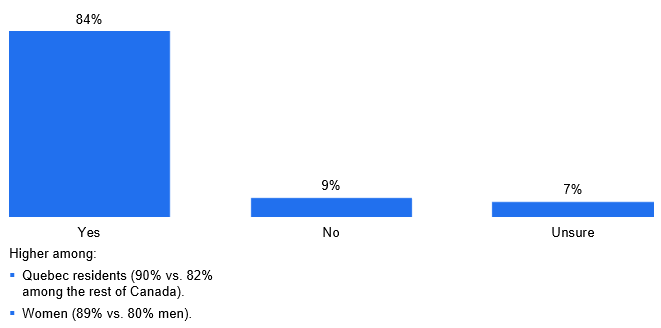
Eighty-four per cent of drivers who use winter tires say that their winter tires have saved them from being involved in a potentially hazardous driving situation such as loss of control or a collision. This supports the view that drivers see winter tires as protective rather than just precautionary. These perceptions highlight drivers’ strong connection to winter tires: They view them as a safety measure that gives them greater confidence and peace of mind when navigating increasingly unpredictable winter road conditions, and not just an optional upgrade. This sense of real-world benefit is strongest among Quebec drivers and women, who are more likely to report that winter tires have directly helped them avoid hazardous driving scenarios.
While there is a strong ongoing trend in utilization of winter tires, three-in-ten motorists outside Quebec still resist equipping their vehicles with winter tires. Top reasons for not owning winter tires are:
Top reasons for not owning winter tires (excluding Quebec):
| Top Reasons | Total | Atlantic | ON | MB/SK | AB | BC |
|---|---|---|---|---|---|---|
| All-season tires are good enough | 75% | 68% | 74% | 77% | 83% | 76% |
| Too expensive | 25% | 32% | 26% | 26% | 25% | 27% |
| I don't drive much in winter | 24% | 0% | 7% | 7% | 25% | 33% |
| I have no place to store off-season tires | 13% | 0% | 0% | 0% | 20% | 19% |
| Other | 1% | 0% | 6% | 6% | 0% | 0% |
| Don’t know/prefer not to answer | 1% | 0% | 0% | 0% | 0% | 2% |
Reasons for Purchasing Winter Tires
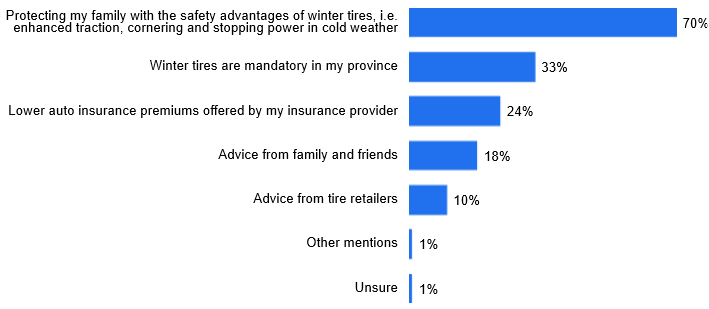
Safety remains the primary reason Canadians choose winter tires. Seven in ten drivers say they use winter tires to protect their families through improved traction, cornering, and stopping performance in cold conditions. Additional motivators include lower auto insurance premiums, cited by 24% of drivers, and recommendations from family, friends, or tire retailers, mentioned by 28%.
Beyond individual safety concerns, broader influences also shape driver behaviour. Winter tire legislation, public education campaigns, and financial incentives such as insurance discounts and low-interest financing programs can greatly influence winter tire adoption. Personal recommendations and shared positive experiences continue to play a powerful role, helping to normalize winter tire use and contribute to safer winter driving across Canada.
Canadian Winter Tire Dilemma: Living Costs vs. Climate Change
Canadian drivers are increasingly caught between financial pressure and the realities of a changing climate. While 76% of drivers agree that extreme winter weather linked to climate change makes winter tires more important than ever, nearly one-third (32%) say rising living costs make them less likely to purchase them. This tension is most pronounced among younger and middle-aged Canadians, lower-income households, and those born outside Canada, where affordability is a growing barrier to safer winter driving.
The data reveals a clear dilemma: Canadians recognize the growing risks of severe winter conditions, yet many are forced to make compromises due to economic strain. Although most drivers still view winter tires as an important safety investment, cost-of-living pressures are reshaping decision-making, creating a gap between what drivers believe is necessary for safety and what they feel they can realistically afford.

National Tire Shipments
The Tire and Rubber Association of Canada tracks all tire shipments into the Canadian market from its members who represent approximately 70% of the tire market in Canada.

*Based on data collected by the Tire and Rubber Association of Canada.
TRAC’s latest analysis of member tire shipments indicates a steady upward trend since 2023, with volumes now approaching the strong levels last seen in 2021. In the colder season, consumers are reminded to look for the Three-Peak Mountain Snowflake (3PMSF) symbol on tire sidewalls. This designation identifies winter tires engineered with specific features and performance capabilities to enhance safety and control in cold temperatures (below 7°C) and snowy conditions.Mahmood Habibnia Director of Operations, TRAC
Road Safety—The Case for Winter Tires
The following findings are supported by a report from the Traffic Injury Research Foundation (TIRF; tirf.ca) citing a range of studies that show conclusively that winter tires provide superior traction, braking and cornering in all cold weather driving conditions, whether the road surface is dry, wet, icy, or snow-covered. Winter tires play a measurable role in increasing road safety and protecting drivers and traffic participants. The use of winter tires contributes to:
- preventing collisions, injuries, and fatalities,
- reducing health and hospital emergency costs,
- reducing the number of police and ambulance emergency responses during winter,
- lowering the frequency and size of insurance payouts,
- reducing traffic congestion.
Quebec—Saving Lives and Reducing Collisions
The superior traction and braking capabilities of winter tires are proven to save lives and reduce personal injuries. The Quebec experience with its mandatory winter tire usage and full data represents the best example.
A 2011 study by Ministère des Transports et de la Mobilité durable demonstrates the road safety benefits of legislating winter tires. After the first two seasons of enforcement (winter 2008-2009/2009-2010):
- winter road collisions decreased by five per cent,
- 574 fewer people were injured annually in winter road collisions,
- deaths and serious injuries due to winter road collisions decreased by three per cent.
Analysis and Insights
Canadian government agencies and road safety groups have been very receptive to the safety advantages of winter tires and continue to work toward increased awareness and driver education in this segment and continue to encourage increased winter tire usage nationwide by providing education, leadership, and guidance. TRAC’s ongoing research into usage of winter tires continues to demonstrate that:
- government mandates, financial incentives, and public awareness campaigns play key role in educating Canadian drivers about safety advantages of winter tires and in persuading them to make the safe choice,
- drivers who use winter tires trust in their efficacy as an important vehicle safety feature,
- growing winter tire utilization contributes to safer roads, reduction in winter road collisions, injury and costs for thousands of Canadian motorists and their families each year.
TRAC’s role focuses on educating government leaders, interest groups, stakeholders and the public about the safety and performance benefits of winter tires; and has been participating in:
- promoting the safety benefits of winter tires with government bodies and traffic safety organizations,
- creating educational resources and campaigns through its consumer oriented Be Tire Smart initiative,
- promoting winter tire usage on government fleet vehicles,
- winter tire messaging on highway signage,
- incorporating winter tire messaging into driver training and handbooks.
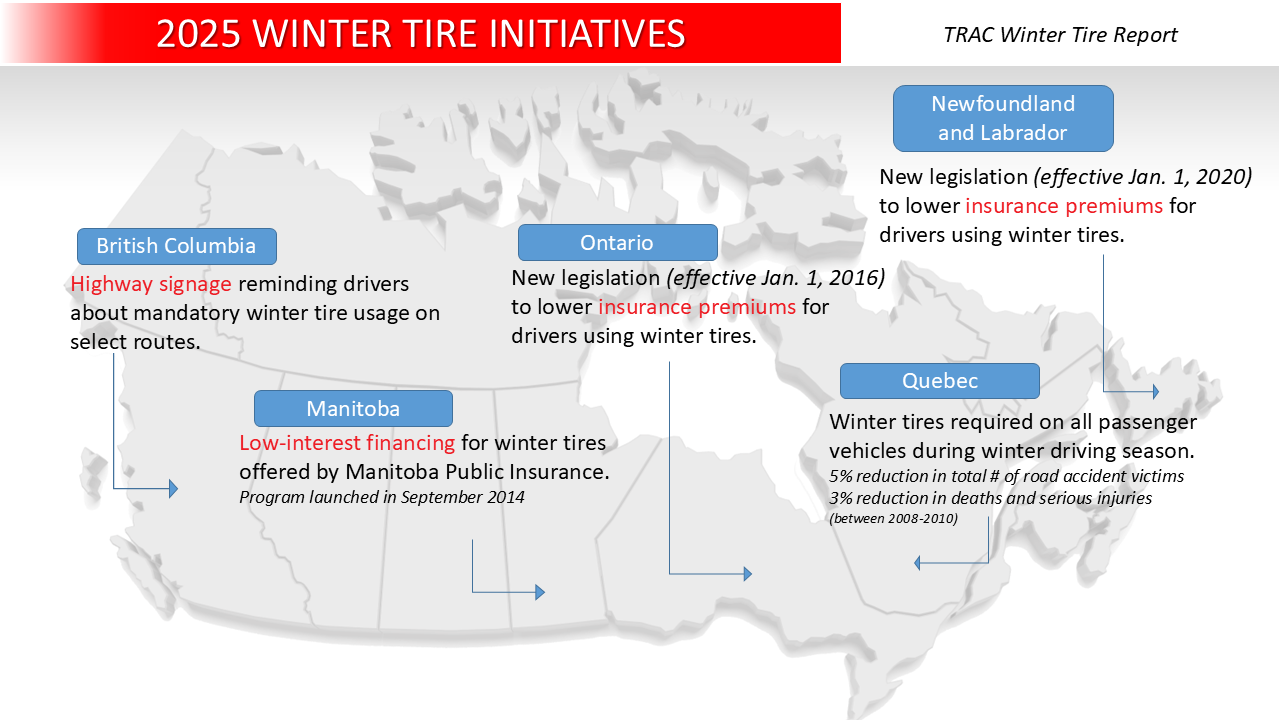
Winter Tire Initiatives by Province
| Province / Initiative | |
|---|---|
| British Columbia | Certain mountainous highways require the use of tires marked with the Three-Peak Mountain Snowflake symbol or M+S marking between October 1st and March 31st. |
| Manitoba | Launched in 2014, Manitoba Public Insurance offers low-interest loans for the purchase and installation of qualified winter tires. The program loans are to a maximum of $2,000 per vehicle, for up to 48 months at the rate of prime, plus two per cent. Since 2014, more than 240,000 applications have been processed. Find more information about the program at mpi.mb.ca. |
| Newfoundland and Labrador | Effective January 1, 2020, the government of Newfoundland and Labrador implemented legislation which requires all insurance providers to reduce auto insurance premiums to drivers who have four winter tires installed on their personal passenger vehicles. Motorists are advised to ask their insurer about how to qualify. |
| Ontario | Effective January 1, 2016, the government of Ontario implemented legislation which requires all insurance providers to reduce auto insurance premiums to drivers who have four winter tires installed on their personal passenger vehicles. Motorists are advised to ask their insurer about how to qualify. |
| Quebec | Since 2008, the Province of Quebec has mandated winter tires on all passenger vehicles. Winter tires are required from Dec. 1st, to Mar. 15th. |
Winter Driving Safety Initiatives by Province
British Columbia
The Winter Driving Safety Alliance is a multi-agency working group that shares a common goal of reducing frequency and severity of winter-related motor vehicle crashes. Committed to improving the safety of drivers during the winter months, the Alliance is comprised of more than a dozen public, private and non-profit bodies, including TRAC.
Manitoba
Manitoba Public Insurance (mpi.mb.ca) is a non-profit Crown Corporation dedicated to keeping Manitoba’s roads safe and vehicle insurance rates low since 1971. Its mandate includes education on winter driving, and the Winter Tire Program which provides low-interest financing for winter tires to eligible Manitobans.
Newfoundland and Labrador
Starting on January 1, 2020, Newfoundland enacted changes to the Automobile Insurance Legislation Changes, and insurers in the province are required to provide a discount for winter tires.
Ontario
The Ontario Ministry of Transportation’s Inter-Agency Road Safety Marketing Committee brings provincial road safety partners together to share information, support joint initiatives and develop awareness campaigns. The Agency works with community groups to promote safe and responsible winter driving practices, and increasing public awareness regarding MTO winter maintenance operations.
Traveler Information Services
Most provinces and territories provide drivers with traveler information services. The 511 road conditions service is available in Newfoundland and Labrador, New Brunswick, Nova Scotia, Prince Edward Island, Quebec, Ontario, Manitoba, Alberta and Yukon. In Saskatchewan, the number is 1-888-335-7623 (toll-free in Canada), in British Columbia it’s 1-800-550-4997 (toll-free in North America), and in Northwest Territories it’s 1-800- 661-0750.
Shopping for Winter Tires
Canadians have many choices when it comes to winter tires. Individual driving habits and skillset, as well as vehicle type, road conditions, and local weather patterns play an important role when it comes to choosing the right winter tire. TRAC encourages drivers to research the tire option that is right for their individual needs: speak with local tire dealer or repair facility and make the decision according to your individual driving needs. Additional information and resources about the safety, performance characteristics, and the list of dedicated winter tires offered by TRAC members for the 2025 winter season can be found here.
Identifying a Winter Tire
A winter tire features the Three-Peak Mountain Snowflake symbol (also referred to as the ‘Alpine Symbol’) on its sidewall. The tire carrying this symbol meets the industry snow traction performance requirements. Winter tires marked with 3PMS symbol must follow the ASTM F-1805 test method on medium-packed snow in standardized testing conditions. Only tires with advanced designs, treads, and rubber compounds can pass this performance-based test. Canadian federal regulation under Transport Canada mandates that all tires that are marked with the 3PMS symbol must meet or exceed a specified minimum threshold.
Winter tire testing is rigorous, reliable, and sophisticated. Winter tires marked with 3PMS symbol must follow the ASTM F-1805 test method on medium-packed snow in standardized testing conditions. Only tires with advanced designs, treads, and rubber compounds can pass this performance-based test. Canadian federal regulation under Transport Canada mandates that all tires that are marked with the 3PMS symbol must meet or exceed a specified minimum threshold.
Additionally, in 2022, the tire industry introduced an Ice Grip Symbol which indicates the tire has passed a specific test method for ice surfaces, according to the standard established by the International Organization for Standardization (ISO). A winter tire that meets snow and ice grip performance minimum levels will have this symbol as well as the 3PMS symbol marked on the tire.
Winter Tire Safety and Performance Benefits of Winter Tires
Winter tires provide superior traction and braking on cold-weather road surfaces. The superior grip of today’s high-tech winter tires is the result of more flexible rubber compounds that provide superior traction even at extremely cold temperatures. These specialized rubber compounds coupled with sophisticated tread designs allow for greater control and braking capability on cold, dry, snow-covered, icy or slushy roads. Shorter stopping distances in emergency situations represent the primary safety feature of the advanced technology in today’s winter tires. Research detailed in the study from Traffic Injury Research Foundation (TIRF; tirf.ca) shows that:
- at temperatures just below freezing, stopping distances for vehicles with winter tires are as much as 30 per cent shorter than for vehicles with all-season tires,
- winter tires deliver better traction on an ice or snow-covered road surface at -30°C vs. all-season tires at 4°C.
Dedicated Winter Tires and Other Winter Tires
Advances in rubber compounding and tire design now offer more choice for consumers when it comes to tires for winter driving. Some dedicated winter tires are designed to perform better in snow, while others are designed to perform better on ice.
While dedicated winter tires are designed specifically for winter conditions, consumers have been introduced to all-season or all-terrain type tires which also display the Three-Peak Mountain Snowflake Symbol. These tires are made to be driven in warmer months as well, while meeting the minimum snow traction performance requirements.
For the very best performance and safety in winter driving TRAC recommends dedicated tires manufactured specifically for winter road conditions. These tires are designed only for use during winter months and should be removed during the non-winter seasons as the tread compound is much too soft for summer driving.
All-Season Tires
As noted earlier, over 50 per cent of drivers currently not using winter tires believe that all-season tires offer sufficient traction and stopping power in winter road conditions. An “all-season” tire implies that it is suitable for all weather conditions; however, these tires do not have the Three-Peak Mountain Snowflake symbol, and do not meet the necessary snow traction requirements to be considered a winter tire.
All-season tires are a compromise when it comes to traction and stopping power during winter driving season.
About Tire and Rubber Association of Canada
The Tire and Rubber Association of Canada (TRAC; tracanada.ca) is the national trade association representing tire makers, rubber product manufacturers and importers as well as rubber recyclers and suppliers of goods and services related to the industry. TRAC is committed to educating drivers regarding proper tire care, maintenance, and usage. A key advocacy goal in the cold-weather months is to raise awareness of safe winter driving as well as the safety and performance benefits of winter tires.
Trusted by