
Member Spotlight: Emterra Group
Emmie Leung on Entrepreneurship, Circularity, and the Future of Tire Recycling The…
Continue Reading
52 minutes ago
| The tire industry is changing quickly. Electric vehicles are creating new demands for tires, sustainability is reshaping how they are made, and customers have more information at their fingertips than ever. For Hankook Tire Canada, the challenge is turning those changes into opportunities.
TRAC spoke with Youngseob (Danny) Yun, President of Hankook Tire Canada, about the company’s plans for growth, the technology driving the business forward, and what he believes the industry needs to do next. |
 |
Yun has spent 16 years with Hankook and has worked across several markets, including Canada, Korea, and Germany. He returned to Canada in 2026 as President, bringing back years of international experience with the company.
For Yun, the immediate goal is clear: “Our priority is to expand Hankook’s footprint in Canada by strengthening customer partnerships, supporting our distribution and dealer networks, and building awareness of our premium product portfolio. To succeed, we must remain close to our customers and understand what they need from us as both a manufacturer and a business partner.”
Hankook’s Canadian products include passenger vehicles, SUVs, light trucks, and commercial vehicles, as well as newer mobility applications. The strength of Hankook Tire is a combination of the company’s global research, engineering and manufacturing capabilities, and deep understanding of local markets. This market understanding includes everything from vehicle preferences, demographics, and vehicle technology to consumer spending habits, driving conditions, and even the physical landscape. Canada’s diverse and often extreme climates, from hot summers to harsh winters, create opportunities to provide solutions for these demanding, real-world, driving conditions.
Image courtesy of Hankook Tire.
In 2025, Hankook became the official and exclusive tire supplier to the FIA World Rally Championship, which means every competing vehicle in the championship uses Hankook tires, competing on surfaces ranging from tarmac and gravel to snow and ice. Of course, the demands of the championship provide the Hankook engineers with information that can feed into the company’s broader tire development. For Hankook, the track is an important space to test and advance what is possible.
“This partnership provides an exceptional environment in which to demonstrate our technology, performance, and durability under some of motorsport’s most challenging and unpredictable conditions,” Yun says.
Image courtesy of Hankook Tire.
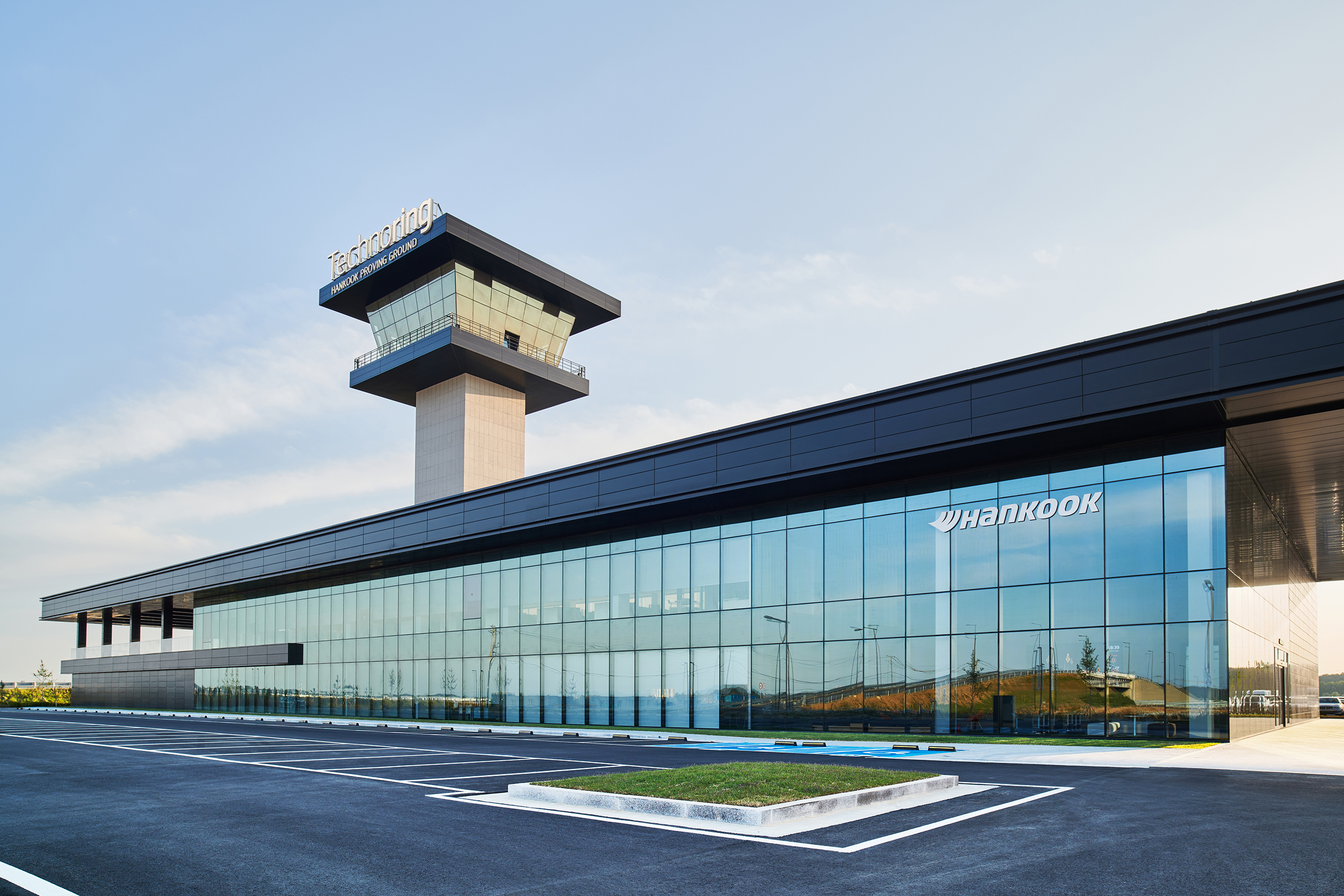
Electrification is one of the biggest forces reshaping the tire business. EVs place different demands on tires because of their weight, instant torque, road noise, and the need to increase range. Hankook is responding with continued research and testing, and the development of EV-specific products such as its iON tire family, and extensive research work at its Technoring, Hankook’s state-of-the-art tire proving ground and Asia’s largest tire testing facility located in Korea.
But Yun sees the transformation as bigger than electric vehicles. “The expanding role of tires in advanced mobility will be one of the greatest opportunities over the next five years,” he says.
As vehicles become more connected and technologically sophisticated, he believes tires will have a larger role in efficiency, comfort, and safety. At the same time, there is an opportunity to make tire production more circular by increasing the use of renewable and recovered materials. Yun says the tire companies that balance innovation, sustainability, performance, and customer value will be well positioned for the future.
Hankook’s sustainability work extends across its value chain, from raw materials through to the end-of-life tire. The company is working toward net-zero emissions by 2050 and increasing its use of renewable and recycled materials. For example, Re:move is Hankook’s scrap tire recycling project that turns excess pieces to upcycled products such as long-boards, shoes, camping gear, and more. Hankook focuses on tire-to-tire circularity, and also expands its ISCC PLUS certification push across its global manufacturing network.
For all the technology going into modern tires, Yun believes one of the industry’s biggest challenges may be communicating that technology to consumers.
“Tires are complex, highly engineered products, but customers should not need technical expertise to recognize which qualities matter for their vehicle and driving needs,” he says.
He would like to see the industry develop clearer language and more recognizable ways of communicating tire performance. The goal is to help consumers understand why one tire may be better suited to a particular vehicle or driving condition rather than making the decision based mainly on price.
“It would make product selection more intuitive and encourage decisions based not only on price, but also on quality, technology, performance, and suitability,” Yun says.
Yun describes his approach to leadership in simple terms: listen and provide clear direction.
“A leader needs to set priorities, but the strongest results come when people understand where the organization is going, contribute their own ideas, and take ownership of the outcome,” he says.
His experience working in Canada, Korea, and Germany has reinforced that philosophy. Different markets bring different expectations, and Yun says there is rarely only one way to reach a goal.
His return to Canada is particularly meaningful. He first worked with Hankook Tire Canada from 2015 to 2019 before moving into other international roles, including Germany. Returning as President in 2026 gives him the chance to bring those experiences together.
“Coming back to Canada as President feels both familiar and new,” he says. “I now have the opportunity to combine what I learned here earlier in my career with the international experience I gained afterward.”
Yun describes the tire industry in one word: “Dynamic.”
For him, that dynamism makes collaboration more important. Electrification, sustainability, regulation, supply chains, and changing consumer expectations are issues that extend beyond individual companies.
“Many issues shaping the tire and rubber industry extend beyond the capabilities of any one company. Meaningful progress requires cooperation among manufacturers, suppliers, customers, recyclers, governments, and industry associations to support a more circular tire industry,” he says.
That is where he sees a role for TRAC and its members. “TRAC provides an important forum for industry dialogue and collaboration on common priorities. When manufacturers, distributors, retailers, recyclers, and other partners communicate openly, the industry becomes more coordinated, resilient, and prepared to navigate long-term change.”
For someone entering the industry, Yun offers equally direct advice: “Stay curious and be willing to step outside your comfort zone.”
His own career reflects that approach. Working across functions, countries, and cultures has broadened his perspective, while teaching him the importance of adaptability, communication and trust.
And when the workday is over, he finds a different kind of challenge on the golf course. “No matter how much you play, there is always something to improve,” he says, which sounds like a fitting outlook for an industry that continues to evolve.
Tire and Rubber Association of Canada
5409 Eglinton Ave W, Suite 208
Etobicoke, ON M9C 5K6
Tel: (437) 880-8420
Email: [email protected]